

When you’re buying, refinancing, or tapping equity, one question quietly shapes everything: how will the lender determine what your home is worth? Two answers dominate the mortgage landscape — the Automated Valuation Model (AVM) and the traditional appraisal — and choosing the wrong one for your situation can cost you thousands or delay your closing by weeks.
This isn’t a rate article. It’s a strategy article. AVMs are fast, free, and increasingly accepted by Fannie Mae and Freddie Mac for certain transaction types. Appraisals are slower, costlier, and — when done right — your strongest negotiating asset. The right answer depends on your loan program, your property type, your equity position, and what you’re actually trying to accomplish.
Understanding the real cost of a home appraisal versus the risks of relying on an AVM is the kind of decision that belongs in a strategy conversation, not buried in lender paperwork. This guide maps both valuation methods to the mortgage programs where each performs best — and shows you the exact math that determines which path protects your deal.
Duane Buziak, NMLS #1110647 | Coast2Coast Mortgage LLC #376205 | Licensed in VA, FL, TN, GA, and DC | (804) 212-8663
AVM vs. Appraisal: Understanding the Strategic Difference
Before mapping these tools to specific programs, it helps to understand what each one actually does — and where each one breaks down.
An Automated Valuation Model is a statistical algorithm that estimates property value using public records, comparable sales data, and market trends. Fannie Mae’s version is called Value Acceptance (formerly Property Inspection Waiver, or PIW). Freddie Mac calls theirs ACE (Automated Collateral Evaluation). When a loan is eligible, the AVM result replaces the appraisal entirely — no appraiser visits the property, no appraisal fee, and typically a faster closing timeline.
A traditional appraisal involves a licensed appraiser physically inspecting the property, reviewing comparable sales, and producing a formal written report. FHA, VA, and USDA loans require this by regulation. Jumbo loans almost always require it. And even on conventional loans where an AVM waiver is technically available, a full appraisal is sometimes the smarter strategic choice.
Here’s where it gets interesting: AVM eligibility isn’t something you choose — it’s something the GSE’s model grants or withholds based on data confidence. If Fannie Mae’s model doesn’t have enough comparable sales in your neighborhood, or your property has unusual characteristics, the waiver won’t be offered. Your broker needs to know this before you’re under contract.
The Math That Makes the Valuation Decision Real
Two scenarios illustrate exactly why the valuation method is a financial variable, not a procedural formality.
Scenario A — Purchase: You’re buying a home at a $500,000 contract price. You’re putting 5% down ($25,000), so your loan amount is $475,000. An AVM comes back at $480,000. Now your LTV is $475,000 ÷ $480,000 = 98.96%. You’ve crossed above the 95% LTV threshold for many conventional programs, which can disqualify you or trigger significantly higher PMI. A full appraisal comes in at $505,000. LTV drops to $475,000 ÷ $505,000 = 94.1% — back within program guidelines. The $600 appraisal fee didn’t just save your deal; it saved your rate tier.
Scenario B — HELOC or Cash-Out Refinance: You believe your home is worth $600,000 and you owe $350,000. An AVM returns $560,000. At 80% CLTV, that means: $560,000 × 0.80 = $448,000 maximum combined debt; minus $350,000 owed = $98,000 accessible equity. A full appraisal comes in at $610,000. Now: $610,000 × 0.80 = $488,000 maximum; minus $350,000 = $138,000 accessible. The difference is $40,000 in additional equity, unlocked by a $600 appraisal. Net gain: approximately $39,400. For anyone exploring home equity options, this math is the entire conversation.
These aren’t hypothetical edge cases. They’re the exact calculations your broker should be running before you commit to a program or a timeline.
Program-by-Program Valuation Map
Different loan programs have fundamentally different valuation requirements. Here’s how the landscape breaks down:
Conventional Conforming (up to $806,500 / $1,209,750 in high-cost areas): AVM waivers are available through Fannie Mae Value Acceptance and Freddie Mac ACE on eligible transactions. Eligibility depends on property type, LTV, transaction purpose, and GSE data confidence. Not guaranteed — but worth checking before ordering an appraisal.
FHA Loans: Full appraisal required by HUD regulation, performed by an FHA-approved appraiser. No AVM substitution. The appraisal also serves as a property condition check against FHA’s Minimum Property Standards. (Source: HUD.gov)
VA Loans: Full VA appraisal required, assigned through VA’s Lender Appraisal Processing Program (LAPP). No AVM substitution. VA appraisals also evaluate Minimum Property Requirements (MPRs). (Source: VA.gov)
USDA Loans: Full appraisal required. No AVM waiver available. (Source: USDA Rural Development)
Jumbo Loans: Typically require a full appraisal. Some private investors accept AVMs or desktop appraisals at conservative LTVs in the 60-65% range, but this is lender-specific and not GSE-mandated.
DSCR and Non-QM: Varies by investor. Some accept AVMs or desktop appraisals at conservative LTVs. For investors evaluating DSCR loan rates and structures, the valuation method directly affects your eligible loan amount and debt service coverage calculation. More on investment property loan strategy is worth reviewing before you run those numbers.
Renovation Loans (203k, HomeStyle): Always require a full appraisal — specifically an “as-completed” appraisal that values the property after planned improvements. No AVM can substitute for this forward-looking valuation.
1. mortgage.shopping — Duane Buziak, NMLS #1110647 (Independent Broker Strategy Session)
Best for: Borrowers who need a strategic partner to navigate AVM eligibility, program fit, and valuation risk across multiple lenders before committing to a deal.
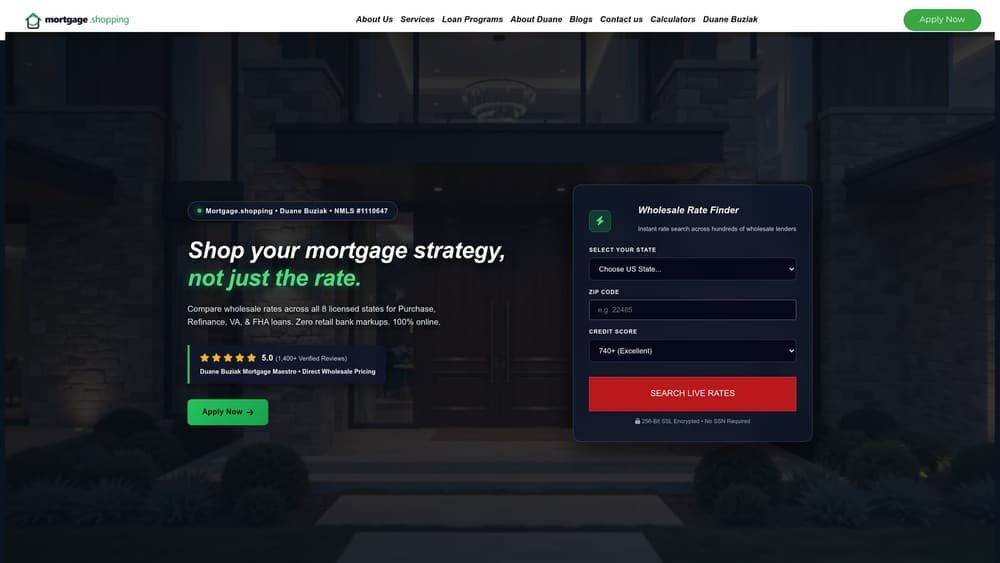
mortgage.shopping is an independent mortgage broker practice built around program strategy — not rate shopping — with access to wholesale lenders across Conventional, FHA, VA, USDA, Jumbo, DSCR, Non-QM, and Renovation 203k programs.
Where This Service Shines
The core advantage here is independence. As a broker licensed in Virginia, Florida, Tennessee, Georgia, and Washington, DC, Duane Buziak isn’t captive to any single lender’s AVM policy. That matters because AVM waiver eligibility varies by investor — one wholesale lender’s model may grant a waiver on your property while another’s won’t. An independent broker can shop that eligibility across multiple investors before you’re locked into a path.
The strategic consultation happens before you’re under contract, which is when it actually matters. By the time you’re in escrow, your options narrow. A pre-contract conversation about your property type, equity position, and target program lets you structure the deal around the valuation method that serves your outcome — not the one your lender defaults to.
Key Features
Wholesale Lender Access for AVM Eligibility: Access to investors participating in Fannie Mae Value Acceptance and Freddie Mac ACE-eligible programs, allowing AVM waiver shopping across multiple lenders.
NoTouch Credit Pull Pre-Qualification: Explore valuation scenarios and program eligibility without a hard inquiry hitting your credit report — critical when you’re still in the decision phase.
Full Program Range: Strategy across Conventional, FHA, VA, USDA, Jumbo, DSCR, Non-QM, and Renovation 203k means you’re not steered toward whatever product a retail lender happens to carry.
Transparent Loan Estimates: Appraisal cost scenarios are disclosed upfront in the loan estimate — no surprise fees mid-process.
ROV Support: If a full appraisal comes in low, the broker can help you build a Reconsideration of Value request using comparable sales evidence, a right strengthened by recent CFPB guidance. (Source: CFPB)
Best For
Move-up buyers, homeowners exploring cash-out refinancing or HELOCs, real estate investors evaluating DSCR or Non-QM structures, and first-time buyers in markets where AVM data confidence is uncertain. Particularly valuable for anyone whose property has unique characteristics that make AVM accuracy questionable.
Pricing
No fee for pre-qualification or strategy consultation. When a full appraisal is required, the fee is disclosed upfront in the loan estimate — typically in the $400-$700 range for standard single-family properties, more for complex or large properties. AVM waivers eliminate this cost entirely on eligible transactions.
2. Rocket Mortgage
Best for: Borrowers with straightforward conventional conforming purchases who want a fully digital experience and early AVM waiver visibility.
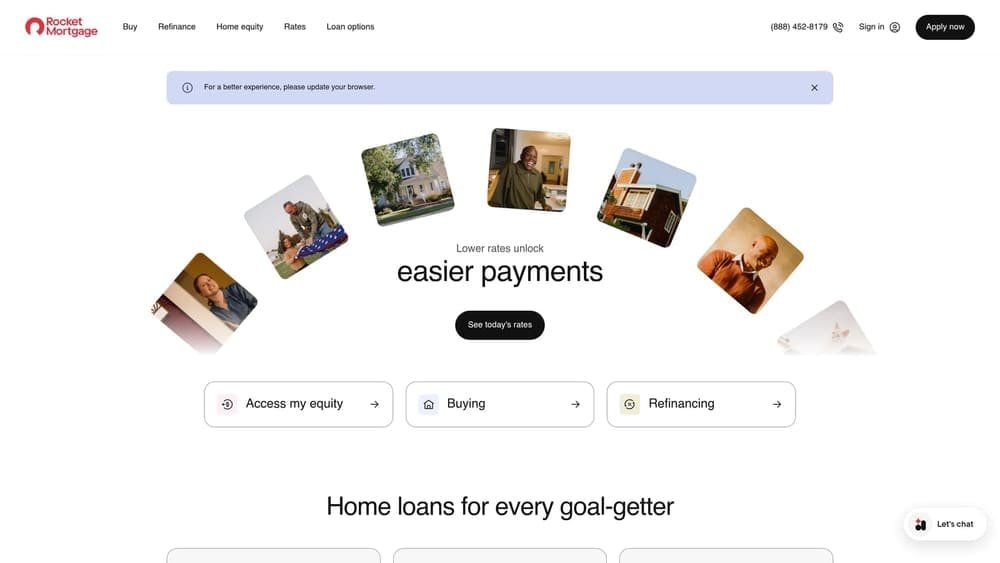
Rocket Mortgage is a large retail broker known for digital-first mortgage processing, participating in both Fannie Mae and Freddie Mac AVM waiver programs on eligible conventional loans.
Where This Tool Shines
Rocket’s digital platform surfaces AVM waiver eligibility relatively early in the application process, which gives borrowers faster clarity on whether an appraisal will be required. For a clean conventional conforming purchase on a property with strong comparable sales data, this can translate to a meaningfully faster closing timeline.
The platform’s appraisal tracking tool is useful when a full appraisal is required — borrowers can monitor order status and timeline without waiting for loan officer updates. That said, Rocket operates as a retail channel, meaning its pricing and lender access differ from what a wholesale broker can offer.
Key Features
AVM Waiver Visibility: Digital platform identifies Fannie/Freddie AVM waiver eligibility during the application flow on eligible conventional loans.
Conventional and Jumbo Products: Conforming and jumbo loan options, though jumbo transactions typically require full appraisals regardless of platform.
Online Appraisal Tracking: Borrowers can monitor appraisal order status when a full appraisal is required.
National Availability: Licensed in most U.S. states, making it accessible for borrowers outside the VA/FL/TN/GA/DC footprint.
Best For
Borrowers who prioritize a fully digital experience and have conventional conforming loan scenarios with strong market data. Less suited for complex property types, non-QM scenarios, or borrowers who want to compare AVM eligibility across multiple wholesale investors.
Pricing
Appraisal fees vary by market and property type. AVM waiver eliminates the appraisal cost on eligible transactions. As a retail channel, origination costs may differ from wholesale broker pricing — worth comparing against a loan estimate from an independent broker before committing.
3. Movement Mortgage
Best for: Borrowers who want a community-focused local loan officer model with access to both AVM-eligible conventional programs and full-appraisal-required FHA and VA products.
Movement Mortgage is a retail mortgage broker with a community-focused model, offering conventional loan products eligible for GSE AVM waivers alongside FHA and VA programs that require full appraisals.

Where This Tool Shines
Movement’s local loan officer model is particularly relevant in markets where AVM data is thin — rural areas, newer subdivisions, or neighborhoods with low transaction volume where GSE models may lack the confidence to grant a waiver. In those markets, a local loan officer who understands the comparable sales landscape can add real value in managing appraisal expectations and timelines.
The combination of conventional AVM-eligible programs and renovation loan products under one roof is useful for borrowers who are weighing a move-in-ready purchase against a fixer-upper — two very different valuation scenarios that benefit from a single strategic conversation.
Key Features
Conventional AVM Eligibility: Purchase and refinance loans eligible for Fannie Mae Value Acceptance and Freddie Mac ACE on qualifying transactions.
FHA and VA Coordination: In-house appraisal coordination for programs requiring full appraisals, including FHA and VA.
Local Loan Officer Model: Useful for markets where AVM data confidence is low and local market knowledge matters.
Renovation Products: Renovation loan offerings where as-completed full appraisals are standard — relevant for borrowers buying properties needing significant work.
Best For
Borrowers in markets with limited comparable sales data, buyers weighing conventional versus renovation loan structures, and those who prefer a local relationship over a fully digital process.
Pricing
Appraisal fees disclosed in loan estimate. AVM waiver eliminates the fee on eligible conventional transactions. As a retail channel, compare loan estimates against wholesale broker pricing for a full cost picture.
4. Veterans United Home Loans
Best for: Active-duty service members and veterans pursuing VA purchase loans who need deep expertise in the VA appraisal process, timelines, and Reconsideration of Value procedures.
Veterans United Home Loans is the largest VA purchase lender in the U.S., exclusively focused on VA loans — which require a VA-assigned appraisal by regulation, making AVM waivers inapplicable for their core product.

Where This Tool Shines
Because VA loans require a full appraisal without exception, the AVM vs. appraisal decision doesn’t apply here — but that doesn’t mean valuation strategy is irrelevant. VA appraisals come with Minimum Property Requirements (MPRs) that can affect deal outcomes, and the Reconsideration of Value (ROV) process is a meaningful tool when an appraisal comes in below contract price. Veterans United’s specialization means their team understands VA appraisal timelines, MPR issues, and ROV procedures at a depth that generalist brokers may not.
For veterans specifically, this depth of VA expertise can be more valuable than AVM waiver access — especially in competitive markets where VA appraisal timelines and MPR requirements sometimes create friction with sellers.
Key Features
VA Appraisal Expertise: Deep knowledge of VA appraisal timelines, VA LAPP (Lender Appraisal Processing Program), and how to manage the process effectively.
MPR Education: Resources on VA Minimum Property Requirements that affect appraisal outcomes and deal structure.
ROV Support: Reconsideration of Value support when VA appraisals come in below contract price — a critical tool for protecting deals in competitive markets.
VA-Specific Focus: Entire operation built around VA loan mechanics, which creates depth unavailable at generalist brokers.
Best For
Veterans and active-duty service members pursuing VA purchase loans who want specialized expertise in VA appraisal processes. Not relevant for conventional, FHA, USDA, or investment property scenarios where AVM waiver eligibility is a meaningful variable.
Pricing
VA appraisal fees are set by the VA fee schedule by state, typically in the $500-$800 range depending on property type and location. The VA funding fee is separate and depends on down payment and loan use history.
5. Guild Mortgage
Best for: Borrowers navigating multiple program options — including down payment assistance, USDA, renovation, and conventional — who benefit from broad program depth at a single retail lender.
Guild Mortgage is a retail broker with broad program depth across conventional, FHA, VA, USDA, and renovation loans — meaning borrowers encounter both AVM waiver-eligible and full-appraisal-required programs under one roof.
Where This Tool Shines
Guild’s program range is its primary strategic value. For a borrower who isn’t yet certain whether they’ll pursue a conventional loan (potentially AVM-eligible) or a USDA loan (full appraisal required), having both options available through a single lender relationship simplifies the decision process. The same applies to borrowers using down payment assistance programs — DPA eligibility often interacts with appraised value thresholds, making the valuation method a direct factor in how much assistance you can access.
Guild’s renovation loan products, including 203k and similar programs, involve as-completed appraisals that require an appraiser to project post-renovation value. This is a specialized appraisal type that benefits from a lender with renovation loan experience.
USDA and FHA Programs: Full appraisal-required programs useful for rural borrowers or those with lower credit scores who don’t qualify for conventional AVM-eligible programs.
Down Payment Assistance Integration: DPA programs where appraised value thresholds directly affect assistance amounts — valuation method matters here.
Renovation Loan Depth: 203k and similar products with as-completed appraisal requirements, handled by a team with renovation loan experience.
Best For
Borrowers in rural markets considering USDA, buyers using down payment assistance programs, and those weighing conventional versus renovation loan structures. Also useful for borrowers who want broad program access without committing to a specific product before seeing their options.
Pricing
Appraisal fees disclosed in loan estimate and vary by program and property type. AVM waivers eliminate the fee on eligible conventional transactions. As a retail channel, compare loan estimates against wholesale broker pricing for total cost accuracy.
Desktop Appraisals: The Middle Ground Worth Knowing
Between a full in-person appraisal and an AVM waiver, there’s a third option that doesn’t get enough attention: the desktop appraisal. Introduced more broadly after 2020, desktop appraisals allow a licensed appraiser to complete a valuation without physically visiting the property — using MLS data, public records, and photos submitted by the borrower or agent.
Fannie Mae and Freddie Mac allow desktop appraisals for certain transactions, and they occupy a useful middle ground: more reliable than a pure AVM in markets with thin data, faster and less expensive than a traditional full appraisal. If your property type or market conditions make an AVM waiver unlikely but a full in-person appraisal feels excessive, a desktop appraisal may be the right fit. Your broker should be evaluating all three options — not defaulting to one.
Reconsideration of Value: Your Rights When the Appraisal Comes In Low
If a full appraisal comes in below your contract price, you’re not without options. The Reconsideration of Value (ROV) process allows borrowers to formally challenge an appraisal by submitting comparable sales the original appraiser may have missed or weighted differently. The CFPB and the GSEs have strengthened ROV rights in recent years, and a well-prepared ROV request with strong comparable evidence can move an appraised value meaningfully. (Source: Consumer Financial Protection Bureau)
The key is preparation. Your broker should be reviewing comparable sales before the appraisal is ordered — not scrambling to find them after a low value comes back. If you’re pursuing a refinance and want to understand the full process before starting, reviewing how to refinance strategically is a useful starting point.
The Valuation Decision Belongs in Your Strategy, Not Your Paperwork
The valuation method on your mortgage isn’t a formality — it’s a strategic variable with real dollar consequences. An AVM waiver on a conventional conforming purchase can save you $600 and shave days off your closing timeline. A full appraisal on a jumbo or unique property can protect you from overpaying or unlock tens of thousands in equity your AVM would have missed.
The five lenders and brokers covered here represent meaningfully different approaches: an independent wholesale broker who can shop AVM eligibility across investors, two retail lenders with conventional AVM-eligible programs and broad product ranges, a VA specialist where appraisal expertise matters more than waiver access, and a program-depth retail lender suited for complex multi-program decisions.
At mortgage.shopping, Duane Buziak works as an independent broker across Virginia, Florida, Tennessee, Georgia, and Washington, DC — ranked as a Scotsman Guide Top Originator (#114, 2025) and recognized as VA Broker of the Year for 2024-2025. The practice is built on the principle that the right mortgage is the one that fits your plans, not just the one with the lowest number on a rate sheet.
Start with a NoTouch Credit Pull pre-qualification to understand which programs and valuation methods apply to your specific scenario before you’re committed to a contract or a closing timeline. The second natural touchpoint for the NoTouch Credit Pull is when you’re modeling equity access — knowing your program eligibility before ordering an appraisal means you’re not paying $600 to discover you don’t qualify for the product you wanted.
Talk to Duane today for a no-obligation strategy conversation with no credit impact — and see exactly how the valuation method on your next mortgage affects your total cost, your program eligibility, and your outcome.
2 Responses